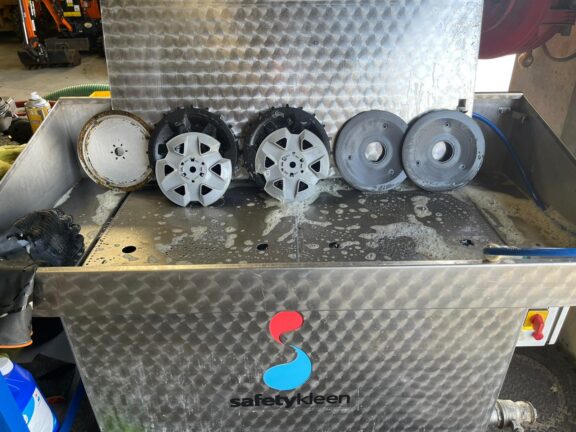
Owens Corning was looking for a better way to clean components in its production plant during maintenance. The process involved a stubborn mixture of glass dust and starch that had previously been treated by an external contractor using acidic substances. Safetykleen provided an alternative that brought the process in-house, removed the need for hazardous acids and delivered significant savings.
-
€
34520
Annual savings
-
Faster
operations
The company and its needs
With 20,000 employees in 33 countries and sales of more than $7 billion, Owens Corning is a US-based company that develops and manufactures fibreglass materials and products, including roofing and insulation materials used primarily in construction, as well as composite materials.
Glass is brittle, but when it is spun into fibres less than a tenth of a millimetre in diameter, it becomes a strong and resilient material. Fibreglass composites can be used across many sectors, including automotive, construction, aerospace and renewable energy.
At the Besana site in Italy, Owens Corning produces more than 63,000 tonnes of fibreglass composites each year from raw mineral powder, which is melted at approximately 1,500°C in a continuous furnace.
The molten glass flows through a system that rapidly cools it to create glass filaments. The resulting glass yarn is processed, stretched and wound onto spools in a process similar to textile-yarn production.
The process requires lubrication of the glass yarn. Friction between the yarn and the metal tooling creates glass powder, which combines with starch to form a paste that settles on machinery and components.
When exposed to air and heat, this mixture hardens into a difficult-to-remove deposit. Regular cleaning is needed to prevent build-up from affecting machine performance.
The sectors are components that transfer movement to the coils around which the glass yarn is wound. Their grooved surfaces are essential to the machinery, but the build-up of glass paste and starch can fill the grooves and eventually prevent the components from working correctly.
Previously, Owens Corning sent these components to an external contractor, where acidic substances were used for cleaning. Outsourcing created long processing times and required additional spare parts to keep production running. The corrosive cleaning process could also damage components over time, so Owens Corning looked to Safetykleen for an alternative.
The Safetykleen solution
Safetykleen’s experts carried out technical tests to identify a simpler, faster and safer way to remove glass paste and starch deposits.
Following successful tests, Owens Corning trialled a Sonickleen 200L ultrasonic tank with Safestrip, a water-based cleaning product classified as non-hazardous and non-flammable, at the Besana site.
The results were immediate: the company was able to clean components thoroughly in two to three hours without coordinating the work with an external supplier and without using a corrosive cleaning product that could damage parts over time.
Owens Corning then entered into a service contract with a four-week service interval, ensuring the machine is maintained and ready to respond to its cleaning requirements.
Results
The new parts-washing solution has delivered significant time and cost savings, while making the maintenance process more flexible and improving operator safety.
Flexibility
Bringing the washing process in-house has made maintenance more flexible. Owens Corning can now schedule cleaning activities independently at the most appropriate times.
With the new solution, the company has eliminated the use of acids and pneumatic chisels for mechanically removing glass paste and starch. Instead, it uses an automatic, enclosed machine with a non-flammable cleaning product classified as non-hazardous.
Saving time and labour
The new cleaning method reduced the time required to clean approximately 200 areas per week from 16 hours to four hours. Based on the hourly cost of the person carrying out the task, this represents a saving of €18,720 per year.
Longer component service life
The switch to a non-corrosive cleaning solution is estimated to increase the average service life of each sector by 30%, from five to six and a half years.
With a unit cost of €170 and 2,016 sectors in the production chain, sector replacement would previously have cost approximately €342,000 every five years. With the new cleaning solution, this falls to around €263,000 – a saving of €79,000 every five years, or €15,800 per year.
Overall, the new cleaning solution provides annual savings of €34,520. After the annual Safetykleen service cost, the resulting net saving is estimated at 60–70% of this figure.
Optimising the parts-washing process has therefore delivered a measurable financial benefit while improving flexibility and safety.