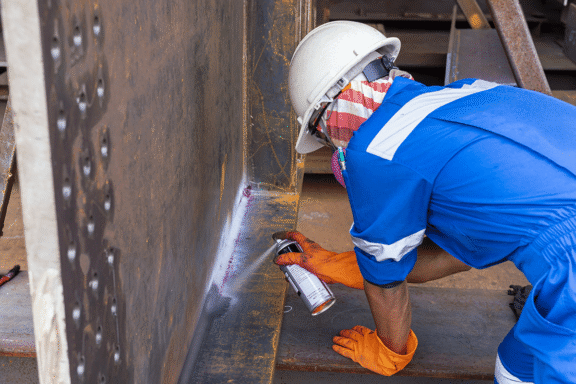
Liquid penetrant testing helps reveal surface defects that may not be visible during a standard inspection. Once a component has passed inspection, the penetrant must be removed thoroughly so it does not interfere with subsequent manufacturing, finishing or inspection processes.
What are liquid penetrants?
Liquid penetrant testing is a non-destructive testing (NDT) method used to reveal surface-breaking defects such as fine cracks and small discontinuities. The penetrant enters these imperfections and makes them visible during inspection.
Why must liquid penetrants be removed?
For components that pass inspection and return to service, residual penetrant can interfere with subsequent processes such as painting, welding or surface treatment. Residues can also affect later NDT inspections and may be incompatible with the component’s operating environment.
How should liquid penetrants be removed?
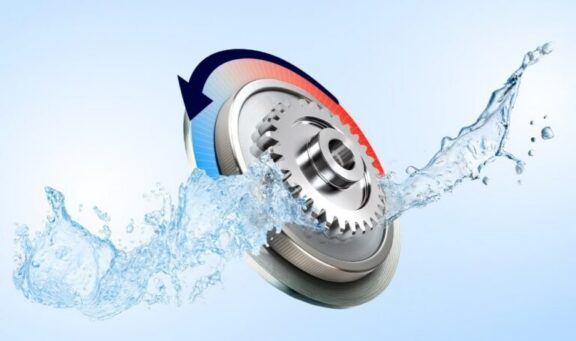
The most appropriate cleaning method depends on component geometry and production volume. Simple components may be suitable for basic immersion or standard parts washing, while complex components with cavities, internal passages or intricate features may require high-pressure or ultrasonic cleaning.
Match the cleaning method to the component
Manual systems can suit straightforward components and lower volumes. Automatic systems can provide repeatable cleaning for higher volumes, while ultrasonic cleaning can reach contaminants in complex geometries where conventional methods may struggle.
Cleaning for quality and compliance
Effective penetrant removal is not simply about appearance. The process should deliver the required cleanliness consistently while supporting operator safety, environmental objectives and the requirements of downstream manufacturing and inspection.